The Making of an Atlantic Ruling Class by Kees Van der Pijl
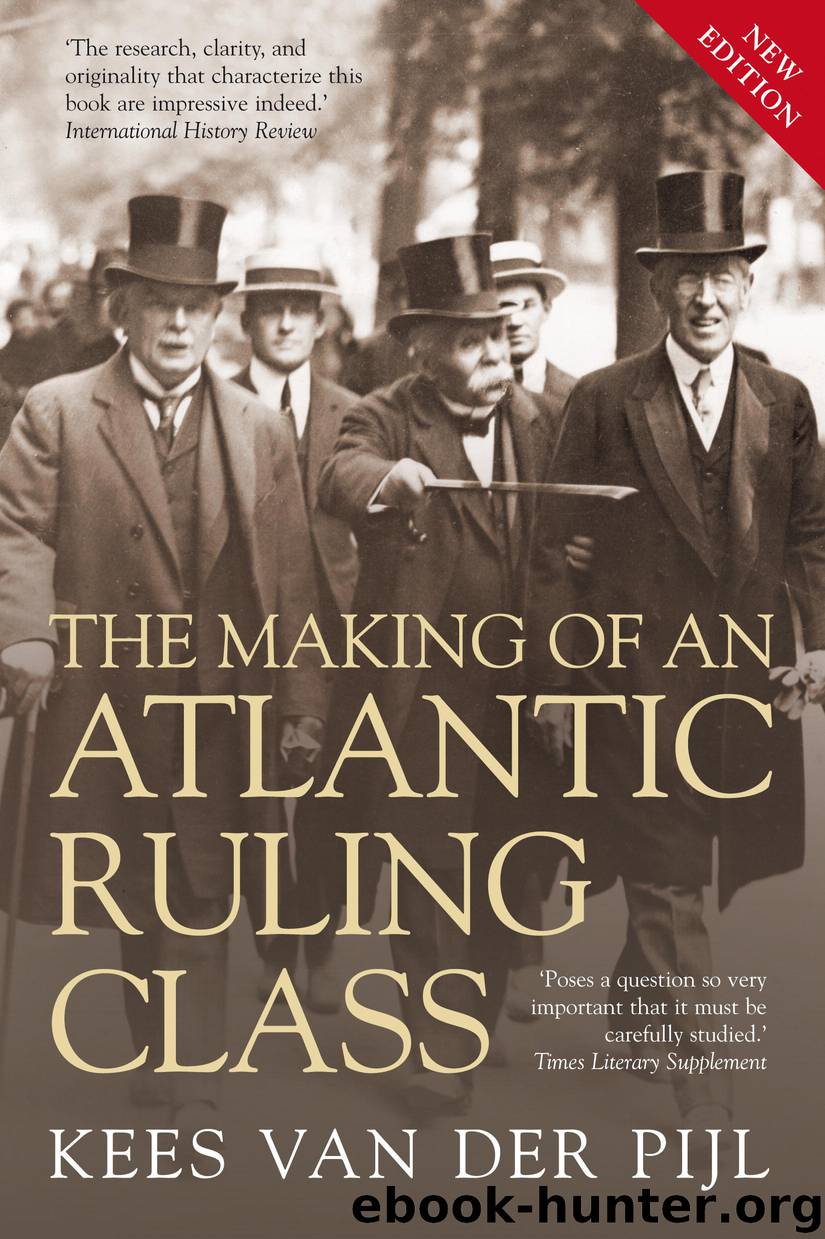
Author:Kees Van der Pijl [Pijl, Kees Van Der]
Language: eng
Format: epub
ISBN: 978-1-84467-936-2
Publisher: Verso Books
Published: 2014-06-03T04:00:00+00:00
The Context of Decolonization
At first sight, it may seem somewhat tendentious to speak of the general dominance of European liberalism in the Marshall period. Only in the Low Countries did the traditional liberal parties actually increase their electoral base, while elsewhere they either lost ground in elections (as in France, Italy and Britain) or failed to gain votes comparable to their pre-war strength (as in Germany). Liberal resurgence accordingly was not a mass phenomenon in party terms. Yet, the American offensive powerfully fostered liberalism in the sense of a pervasive awareness that society was in need of an internationalist, essentially private-individualist turn of class relations if it was to withstand the challenge of socialism.
But it did so by restructuring the previous liberal internationalism rather than consolidating it. Through the Marshall offensive, the Pax Americana was imposed on the economic ruins of the defunct Pax Britannica in Europe. This in turn required the euthanasia of residual class fractions related to the pre-war accumulation and profit-distribution structures and colonialism; and thus, a struggle to eliminate or restructure the political parties hitherto expressing the interests of these fractions. Paradoxically, the new liberalism in a number of cases found its most stubborn opponent in the Liberal parties, which were often still the domain of the ‘old’ middle class. The German FDP until 1956 was a right-wing small entrepreneur party; in France, this category was represented by Pinay’s Independents, while the Radical Party at the time was more urban and oriented to big capital (Mayer) and, subsequently, to the corporate-liberal technocracy (Mendès-France).97
The link between class formation and Liberal prominence on the one hand, and the Marshall offensive on the other, has to be analysed against the background of a fundamental restructuring of the liberal-internationalist bourgeoisie itself in the context of the restructuring of the world economy. This can be illustrated for the Netherlands, where because of the coincidence of Atlantic alliance and the decolonization of Indonesia, its impact was greatest.
The American liberal offensive in the course of 1947 included diplomatic recognition of Sukarno’s Republic in April and an invitation for Indonesia to attend the International Trade Conference in Havana in August. Among Dutch capitalists in Indonesia, opinions as to how to deal with the nationalist challenge were divided. Strong industrial capitals catering to consumer demand in Indonesia, like Unilever and Heineken, as well as the strongest among the plantation interests, were in favour of a neo-colonialist compromise pacifying both the Americans and the Indonesian bourgeoisie led by Hatta. The smaller planters, dependent on primitive exploitation relations and government trade channels, joined by the rentier class and the conservatives in the Netherlands, wanted strong action. This division extended well into the Liberal party. Oud and his Rotterdam constituency, with its background in trade, shipping, and industry, and Stikker, director of Heineken and NHM, subscribed to the neo-colonialist solution as part of the Atlantic Union concept. In Amsterdam, however, the party was strong among bank and stock-exchange employees dependent on Indonesian ventures for their livelihood and fervently in support of conservative colonialism.
Download
This site does not store any files on its server. We only index and link to content provided by other sites. Please contact the content providers to delete copyright contents if any and email us, we'll remove relevant links or contents immediately.
| Anthropology | Archaeology |
| Philosophy | Politics & Government |
| Social Sciences | Sociology |
| Women's Studies |
The Secret History by Donna Tartt(19092)
The Social Justice Warrior Handbook by Lisa De Pasquale(12190)
Thirteen Reasons Why by Jay Asher(8912)
This Is How You Lose Her by Junot Diaz(6887)
Weapons of Math Destruction by Cathy O'Neil(6281)
Zero to One by Peter Thiel(5802)
Beartown by Fredrik Backman(5755)
The Myth of the Strong Leader by Archie Brown(5508)
The Fire Next Time by James Baldwin(5447)
How Democracies Die by Steven Levitsky & Daniel Ziblatt(5219)
Promise Me, Dad by Joe Biden(5154)
Stone's Rules by Roger Stone(5088)
A Higher Loyalty: Truth, Lies, and Leadership by James Comey(4964)
100 Deadly Skills by Clint Emerson(4926)
Rise and Kill First by Ronen Bergman(4790)
Secrecy World by Jake Bernstein(4753)
The David Icke Guide to the Global Conspiracy (and how to end it) by David Icke(4720)
The Farm by Tom Rob Smith(4514)
The Doomsday Machine by Daniel Ellsberg(4490)
